

Pickleball is a fun, fast-paced sport gaining popularity. Skinny singles pickleball is a unique variation.
Understanding the court dimensions is crucial for players. Skinny singles pickleball offers a thrilling twist on the traditional game. Unlike regular pickleball, it uses a narrower court. This change makes the game more challenging and strategic. Players need to adapt their skills and tactics to the smaller play area.
Knowing the exact dimensions helps players set up their own courts at home or in local parks. It ensures fair play and enhances the overall experience. Dive into the world of skinny singles pickleball and learn about its distinct court dimensions for a better game.

Credit: masspickleballguide.com
Contents
Introduction To Skinny Singles Pickleball
Skinny Singles Pickleball is a fun and engaging variation of traditional pickleball. It offers a unique twist by narrowing the court dimensions, making it a perfect choice for players seeking a different challenge. This format is gaining popularity among pickleball enthusiasts due to its simplicity and exciting gameplay. Let’s dive into the details of Skinny Singles Pickleball.
What Is Skinny Singles?
Skinny Singles is a modified version of pickleball played on a narrower court. The court’s width is reduced, making the game more challenging and fast-paced. Unlike the standard pickleball court, which is 20 feet wide, the Skinny Singles court is only 10 feet wide.
| Standard Court | Skinny Singles Court |
|---|---|
| 20 feet wide | 10 feet wide |
| 44 feet long | 44 feet long |
The length of the court remains the same at 44 feet. This narrower court requires players to be more precise and strategic with their shots. The game is typically played one-on-one, adding to the intensity and competitiveness.
Popularity And Benefits
Skinny Singles Pickleball is becoming increasingly popular among players of all skill levels. Its unique court dimensions offer several benefits:
- Improves accuracy: Players must hit more precise shots, enhancing their accuracy.
- Enhances agility: The narrower court requires quick movements and better footwork.
- Boosts strategy: Players need to think strategically to outmaneuver their opponents.
- Increases fitness: The fast-paced nature of Skinny Singles provides a great workout.
These benefits make Skinny Singles Pickleball a favorite among those looking to improve their skills and enjoy a more intense game.
Official Court Dimensions
Understanding the official dimensions of a Skinny Singles pickleball court is essential for proper gameplay. This guide covers the court’s length and width, and the net’s height and placement. Let’s dive into the specifics to ensure your court meets the official standards.
Court Length And Width
The official length of a Skinny Singles pickleball court is 44 feet. The width, however, is narrower than standard pickleball courts. It measures only 10 feet. This compact size makes the game more challenging and fun. The smaller court requires precise shots and quick reflexes. Ensure you have the correct measurements for an authentic experience.
Net Height And Placement
The net height is crucial in Skinny Singles pickleball. The standard height at the center is 34 inches. At the posts, the height should be 36 inches. Proper net placement ensures fair play and consistency. Position the net so it splits the court evenly. This will maintain balance and fairness in every match.
Marking The Court
Marking a Skinny Singles Pickleball Court can seem daunting, but it’s quite simple. Accurate markings ensure fair play and clear boundaries. Let’s break down how to mark the essential parts of the court.
Baseline And Sideline
The baseline and sideline are crucial for defining the court’s playing area. The baseline runs parallel to the net and is located at each end of the court. Each baseline is 20 feet long, marking the width of the court.
The sidelines run perpendicular to the net and extend from one baseline to the other. Each sideline is 44 feet long, marking the length of the court. Ensure that both baselines and sidelines are clearly marked to avoid disputes during the game.
Non-volley Zone
The non-volley zone (also known as the kitchen) is a key area in pickleball. This zone is 7 feet from the net on both sides. It spans the entire width of the court, from sideline to sideline.
To mark the non-volley zone, measure 7 feet from the net and draw a line parallel to it. Do this on both sides of the net. This area restricts players from volleying, promoting strategic play.
Here is a simple table to summarize the dimensions:
| Part of Court | Dimension |
|---|---|
| Baseline | 20 feet |
| Sideline | 44 feet |
| Non-Volley Zone | 7 feet from net |
Marking these areas correctly ensures a fair and enjoyable game. Happy playing!
Equipment Needed
Playing pickleball on a skinny singles court is fun and exciting. But you need the right equipment to enjoy the game. This section focuses on the essential gear required.
Paddles And Balls
Every player needs a good paddle. Choose one that feels comfortable. Lightweight paddles are easier to handle. They help you play for longer periods. You also need pickleball balls. These are plastic with holes. They come in different colors. Bright colors are easy to see on the court.
Court Accessories
A net is a must for any pickleball court. Make sure it is the correct height. The standard height is 36 inches at the sidelines. It is 34 inches in the middle. Boundary lines are also important. Use tape or chalk to mark the court. Keep a measuring tape handy for accuracy. A scoreboard can help track the game. It keeps the game fair and fun. Comfortable shoes are also vital. They should provide good grip and support.
Setting Up The Court
Creating the perfect skinny singles pickleball court requires careful planning. Start by understanding the dimensions. Then, follow these simple steps to set up your court. This guide will help you create a great playing area. Let’s dive into the details.
Choosing The Location
Select a flat and even surface. Avoid areas with slopes or bumps. Concrete and asphalt work best. Grass can be tricky but is still an option. Ensure the space is large enough. Measure the area to confirm.
Step-by-step Setup
First, mark the baseline. Measure 20 feet for the width. Mark both ends with tape or chalk. Next, measure 22 feet for the length. Mark the ends to create a rectangle. Check the corners for accuracy.
Second, mark the centerline. Measure and mark the midpoint of the baseline. Draw a line to the opposite baseline midpoint. This divides the court into two halves. Each half is 10 feet by 22 feet.
Third, mark the non-volley zone. Measure 7 feet from the net on each side. Draw parallel lines. These lines create a zone 14 feet wide across the court. This area is also known as the kitchen.
Finally, set up the net. Place it at the centerline. Ensure the net is 36 inches high at the sidelines. At the center, it should be 34 inches high. Use a measuring tape to check the height.
Now your skinny singles pickleball court is ready. Enjoy your game!
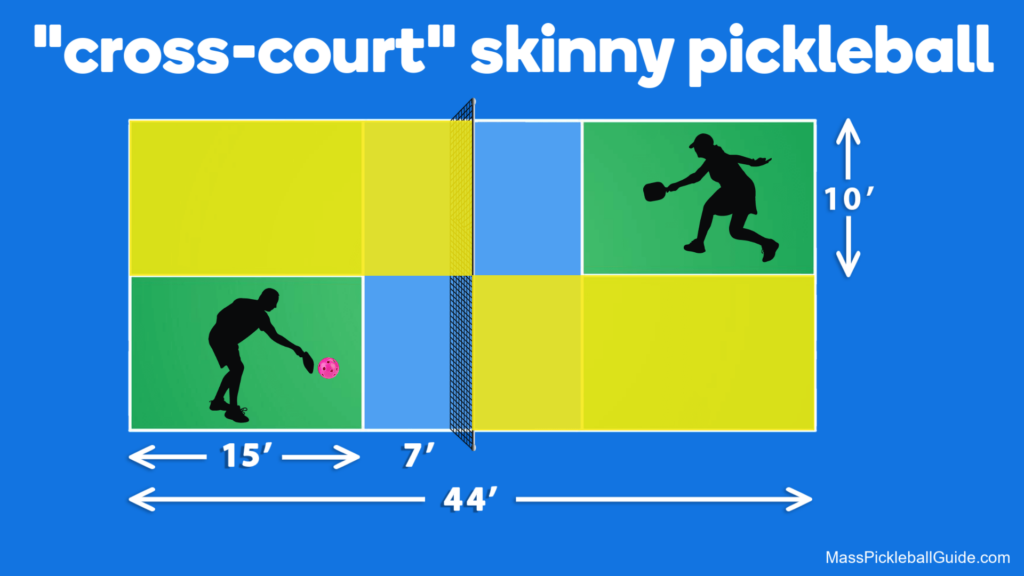
Credit: masspickleballguide.com
Playing Skinny Singles
Playing Skinny Singles in pickleball offers a unique challenge. The smaller court size requires precision and agility. Unlike traditional doubles, Skinny Singles focuses on individual skill and strategy. The game is fast-paced, keeping players on their toes. Understanding the rules and scoring system is crucial for a successful game.
Basic Rules
Skinny Singles follows similar rules to regular pickleball. The court dimensions are smaller, with a width of 10 feet. Players serve diagonally, aiming for their opponent’s service box. Both players must stay within their respective halves. The ball must clear the net and land in the correct service area. Faults occur if the ball lands out or doesn’t clear the net.
Scoring System
The scoring system in Skinny Singles is straightforward. Players can only score points on their serve. The game is played to 11 points, with a two-point lead required to win. Each rally starts with a serve. If the server wins the rally, they score a point and serve again. If the receiver wins the rally, they gain the serve.
Keeping track of the score is essential. Both players need to announce the score before each serve. This ensures clarity and helps avoid disputes. The first player to reach 11 points with a two-point lead wins the game.
Tips For Beginners
Starting with Skinny Singles Pickleball can be exciting and fun. Yet, there are many things beginners need to know to improve their game. Here are some tips to help you get started on the right foot.
Improving Your Game
Practice your serves often. A good serve can set the tone of the game. Work on your footwork. Moving quickly and efficiently can give you an edge. Focus on your positioning. Stand in the right spot to make your shots more effective. Play with others who are better than you. It helps you learn faster. Watch videos of professional players. Observe their techniques and try to mimic them.
Common Mistakes To Avoid
Many beginners grip the paddle too tightly. This can reduce your control. Hold it firmly, but not too tight. Avoid standing too close to the net. This can make it hard to react to fast shots. Do not rush your shots. Take your time to aim properly. Forgetting to warm up can lead to injuries. Always start with a good warm-up session. Overthinking your moves can slow you down. Play naturally and trust your instincts.
Advanced Strategies
Advanced strategies in Skinny Singles Pickleball can elevate your game. They involve a mix of offensive and defensive techniques. Understanding these strategies can help you gain an edge over your opponents. Let’s explore some key offensive and defensive techniques.
Offensive Techniques
Offensive techniques aim to put pressure on your opponent. One effective method is the drop shot. It’s a soft shot that lands just over the net. This forces your opponent to move quickly. Another strategy is the drive shot. This is a fast, low shot aimed at the opponent’s feet. It is hard to return.
Using angles can also be very effective. Hitting the ball to the corners of the court can make your opponent run more. This creates openings for you to exploit. The dink shot is another useful tool. It’s a soft shot that just clears the net and drops quickly. This forces your opponent to move forward and disrupts their rhythm.
Defensive Techniques
Defensive techniques are just as important. The goal is to keep the ball in play and force errors. One key technique is the lob. It’s a high, deep shot that pushes your opponent to the back of the court. This buys you time to recover your position.
Another defensive strategy is the block shot. It’s used to neutralize a powerful shot from your opponent. By absorbing the ball’s energy, you can control the pace of the game. Consistency is crucial in defense. Keeping the ball in play and reducing unforced errors can frustrate your opponent and lead to mistakes.
Anticipation is also a valuable skill. Reading your opponent’s body language and predicting their next move can give you an advantage. This allows you to position yourself better and respond more effectively.
Incorporating these advanced strategies into your game can significantly improve your performance on the Skinny Singles Pickleball court. Practice and experience will help you refine these techniques and become a more formidable player.

Credit: www.pickleballify.com
Frequently Asked Questions
What Are The Dimensions Of A Skinny Singles Pickleball Court?
A skinny singles pickleball court is 20 feet wide and 44 feet long. The non-volley zone, also called the kitchen, is 7 feet from the net on each side.
How Wide Is A Pickleball Court For Singles?
A pickleball court for singles is 20 feet wide. This width accommodates the gameplay for both singles and doubles matches.
What Is The Size Of A Pickleball Non-volley Zone?
The non-volley zone, or kitchen, in pickleball is 7 feet from the net on both sides. This area restricts volleys to enhance game strategy.
How Long Is A Pickleball Court?
A pickleball court is 44 feet long. This length is standardized for both singles and doubles matches.
Conclusion
Understanding skinny singles pickleball court dimensions can enhance your game experience. Knowing the court size helps in better planning and play. Keep practicing on these dimensions for improved skills. Remember, consistency is key in any sport. Make sure to measure your court correctly.
This ensures fair play and enjoyment. Stay active and have fun on the court.
