How to Hit a Fade: Simple Steps for Perfect Golf Shots

Golfers often talk about drawing and fading the ball, but for many, how to hit a fade remains a mystery. A fade is a controlled shot that starts left of the target (for a right-handed golfer) and gently curves back to the right. It’s not a slice, which is uncontrolled and usually unintentional; a fade is precise and purposeful. Professional golfers rely on the fade for accuracy, especially under pressure, because it offers more control and predictability than a draw or straight shot. If you want to improve your golf game, learning the fade is a must.
Many amateur golfers believe hitting a fade is only for low-handicap players, but that’s not true. With the right fundamentals, anyone can learn this shot. In this article, we’ll break down every step, from grip and stance to the mental side of shot shaping.
You’ll discover practical techniques, common mistakes, and tips from experienced players. We’ll also address questions beginners often miss and look at data comparing fades to other shot shapes. By the end, you’ll not only know how to hit a fade—you’ll understand when and why to use it for better scores.
What Is A Fade In Golf?
A fade is a golf shot that curves slightly from left to right (for a right-handed golfer). For left-handed players, the fade moves from right to left. The curve is gentle, typically moving three to five yards for iron shots and up to ten yards for drives.
Unlike a slice, which is an uncontrolled and exaggerated curve, a fade is intentional and precise.
The fade is popular because it provides more control. Many top PGA Tour players, like Jack Nicklaus and Dustin Johnson, use fades off the tee for accuracy. The ball lands softly and stops quickly, making it easier to hit fairways and greens.
Why Learn To Hit A Fade?
Some golfers wonder why they should bother learning a fade. Here are key reasons:
- Control: Fades help you avoid trouble on the left side of the hole. You can aim left and let the ball drift back.
- Consistency: A fade is easier to repeat than a draw for many players, especially under pressure.
- Course Management: Many holes are designed with fades in mind, especially dogleg-right fairways.
- Wind Play: Fades hold up better against left-to-right wind, making shot planning simpler.
- Spin: Fades naturally produce more backspin, which helps the ball stop faster on the green.
Many golfers also find that learning a fade improves their understanding of swing mechanics, leading to better overall ball striking.
The Basic Mechanics Of A Fade
Understanding the mechanics behind the fade is essential. A fade is created by a combination of swing path and clubface angle:
- Swing Path: For a right-handed player, the clubhead should travel slightly from outside to inside through the ball.
- Clubface Angle: The clubface should be open (pointing right of the target) but less open than the swing path.
The difference between the swing path and clubface angle produces the left-to-right spin. If the clubface is too open compared to the path, you’ll slice. If it’s only slightly open, you’ll get a controlled fade.
Let’s look at the differences between a fade, a slice, and a draw:
| Shot Shape | Start Direction | Curve | Typical Cause |
|---|---|---|---|
| Fade | Left of target | Slight right | Open clubface, outside-in path |
| Slice | Left of target | Strong right | Clubface too open, steep outside-in path |
| Draw | Right of target | Slight left | Closed clubface, inside-out path |
Setting Up For A Fade
Your setup is the foundation for a good fade. Here’s what to focus on:
Alignment
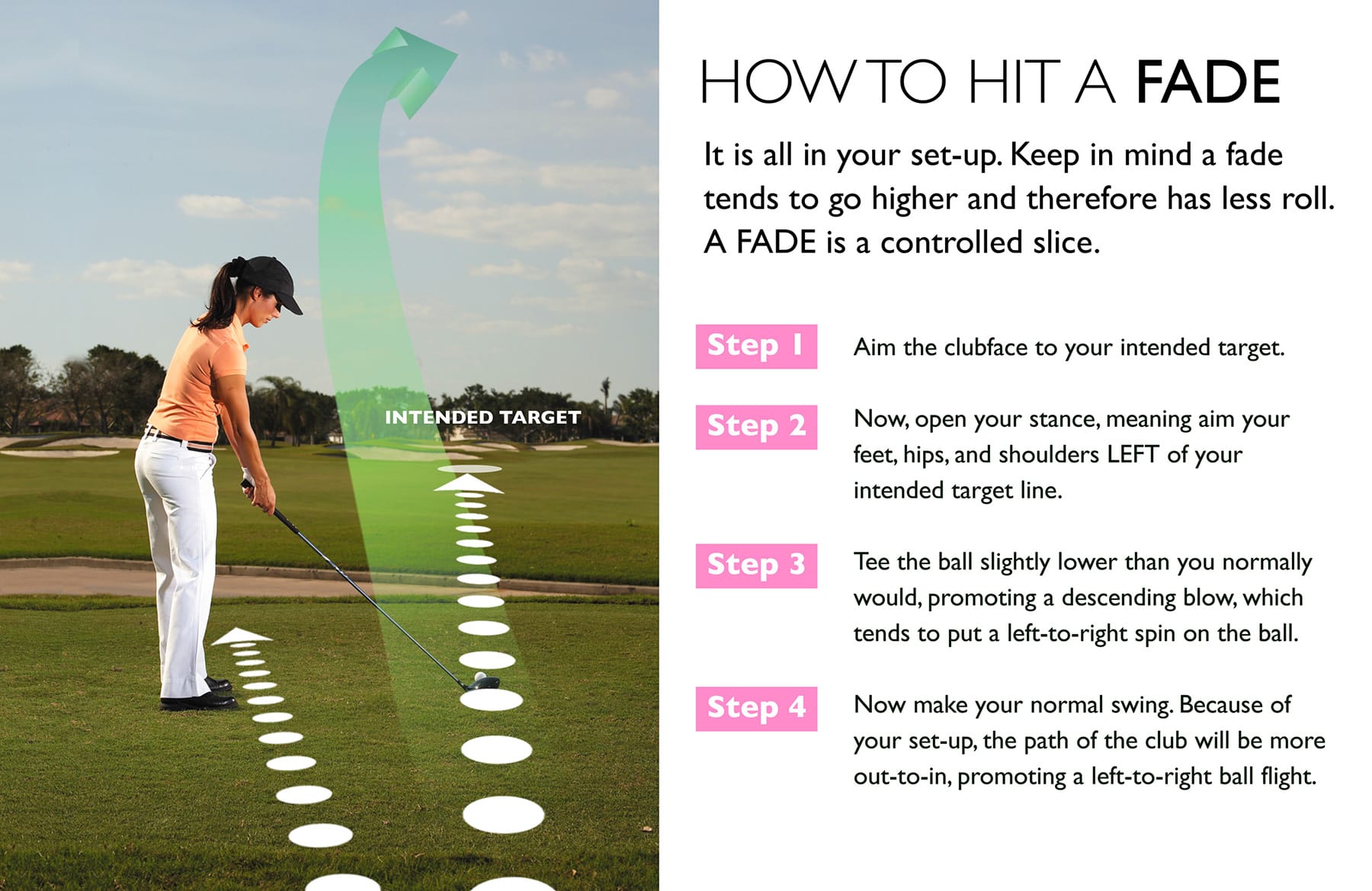
- Feet, hips, and shoulders should be aimed left of the target (for a right-handed player).
- The clubface should be aimed at or slightly right of the target.
Picture a railroad track: your body is on the left rail, the clubface is on the right. This setup encourages the correct swing path and face angle.
Ball Position
- Place the ball slightly forward in your stance, about one to two balls ahead of center.
- This helps you catch the ball after the low point, with the club moving left.
Grip
- Keep your grip neutral—not too strong (right hand under) or too weak (right hand over).
- A slightly weaker grip can help keep the clubface open, but avoid overdoing it.
Stance
- Stand shoulder-width apart for balance.
- Keep your weight evenly distributed.
Many beginners miss the importance of setup. Even small errors in alignment or ball position can turn a fade into a slice or push. Taking time to set up correctly is one of the quickest ways to see improvement.
How To Hit A Fade: Step-by-step
Let’s break down the process into clear steps:
1. Choose Your Target
Pick a spot where you want the ball to finish, then choose a starting line slightly left of that spot.
2. Take Your Stance
Set your feet, hips, and shoulders parallel to your starting line (left of target for right-handers).
3. Aim The Clubface
Point the clubface at the final target or just right of it.
4. Grip The Club
Use a neutral or slightly weak grip. Check that your hands are not turning the clubface closed.
5. Ball Position
Place the ball forward in your stance.
6. Make A Controlled Swing
Swing along your body line (left of the target for right-handers). Focus on an outside-in path.
7. Release The Club Correctly
Allow your hands to turn naturally through impact, but don’t flip the clubface closed. The clubface should stay slightly open relative to the path.
8. Follow Through
Finish with your chest facing the target and your weight on your left foot (for right-handers).
Here’s a simple comparison of fade vs. draw setup:
| Setup Element | Fade | Draw |
|---|---|---|
| Body Alignment | Left of target | Right of target |
| Clubface | At target | At target |
| Swing Path | Outside-in | Inside-out |
| Ball Position | Forward | Back/middle |
Common Mistakes When Hitting A Fade
Many golfers struggle to hit a fade on command because they make the same errors. Watch out for these common problems:
1. Open Clubface Too Much
If the clubface is open too far relative to your swing path, you’ll slice rather than fade.
2. Over-the-top Swing
Swinging steeply from outside the line causes a slice and loss of distance.
3. Grip Too Weak
A very weak grip can make it hard to control the clubface, resulting in poor contact.
4. Poor Ball Position
Ball too far back leads to hooks; too far forward leads to weak fades or slices.
5. No Follow-through
Decelerating or stopping your swing can cause thin shots or pushes.
6. Trying To Manipulate The Hands
Forcing the hands open at impact can ruin consistency. Let the swing produce the fade.
An insight many beginners miss: you don’t need a big swing change. Small adjustments in setup and swing path are usually enough. Overcorrecting often makes things worse.
Credit: www.morepars.com
Advanced Fade Techniques
Once you can hit a basic fade, you can refine your technique for more control and different situations.
The Power Fade
The power fade is a favorite among professionals like Tiger Woods. It’s a fade with minimal loss of distance. To hit a power fade:
- Set up as for a regular fade, but keep your grip firmer in the last three fingers of your left hand.
- Focus on a strong, aggressive turn through the ball.
- Make sure your upper body leads the downswing, not your hands.
- Try to keep your swing speed up—many amateurs lose power by swinging too softly.
Fading With Different Clubs
Fades work with every club, but some require adjustments:
- Driver: Tee the ball slightly lower, aim left, and focus on a smooth swing. The driver’s loft exaggerates fade spin.
- Irons: Ball forward, but don’t open the face too much. Aim for a controlled curve.
- Wedges: Fades help with pin-seeking shots. Use a slightly open stance and make sure to accelerate through the ball.
Fade Under Pressure
Hitting a fade in competition or under pressure is about trust. Many golfers fear the right side and close the clubface at the last second. The key is to trust your setup and swing path. Practice fades on the range, then use them on the course to build confidence.
When To Use A Fade On The Course
A fade is not just a “show-off” shot—it’s a practical tool for many situations:
- Dogleg Right Holes: A fade matches the shape of the hole, making it easier to find the fairway.
- Approaching Tight Pins: Fades stop faster on the green, helping you attack tough pin positions.
- Avoiding Hazards: If trouble is left, a fade lets you start left and curve away from danger.
- Wind Management: Fades work well with left-to-right winds, reducing the risk of a big miss.
Some golfers make the mistake of using a fade only off the tee. In reality, it’s useful for approach shots, recovery shots, and even certain chip shots around the green.
Credit: whygolf.com
Data: Fade Vs. Draw Performance
Let’s look at how fades and draws compare in terms of distance, accuracy, and spin:
| Shot Shape | Average Distance (Driver) | Fairway Hit % | Spin Rate (RPM) |
|---|---|---|---|
| Fade | 265 yards | 62% | 2800 |
| Draw | 272 yards | 56% | 2400 |
As you can see, fades offer more fairways hit and higher spin rates, which means better control but a slight loss in distance. For most amateur golfers, the extra control is worth more than a few extra yards.
Drills To Practice Hitting A Fade
Improvement comes from practice, not just theory. Here are some fade-specific drills:
1. Alignment Stick Drill
- Place an alignment stick on the ground pointing left of your target (for right-handers).
- Set up with your feet, hips, and shoulders parallel to the stick.
- Aim the clubface at the target.
- Practice swinging along your body line while keeping the clubface pointing at the target.
This helps you build the correct path and face relationship.
2. Two-tee Drill
- Place one tee at your ball position and another a few inches outside the target line.
- Try to swing the clubhead just outside the second tee, promoting an outside-in path.
3. Ball Flight Feedback
- On the range, set a goal: Start the ball left, curve it back 5–10 yards.
- Track how many shots fade as intended out of ten. Consistency is more important than a perfect shot.
One insight beginners often miss: ball flight is the best teacher. Instead of guessing, watch where the ball starts and curves, then adjust your setup or swing. Video your swing if possible and compare to your feels.
The Mental Side Of Hitting A Fade
Golf is as much mental as physical. Many golfers fear missing right and subconsciously close the clubface, leading to hooks or pulls. Trusting the fade means accepting that the ball will start left and curve right.
Visualization helps. Before each shot, picture the ball flight in your mind. Imagine the ball starting left of your target, then gently floating back to the target. This mental rehearsal builds confidence and helps you commit to the shot.
Some players create a simple pre-shot routine: pick the start line, pick the finish line, take a deep breath, and swing with intent. Sticking to this routine under pressure makes it easier to repeat your fade swing.
Equipment Tips For Hitting A Fade
Your clubs can influence your ability to hit a fade:
- Shaft Flex: Stiffer shafts help control fade spin, especially with drivers.
- Driver Settings: Many modern drivers let you adjust loft and face angle. Setting to “fade” bias can help.
- Ball Choice: Higher spin balls exaggerate fades, while low spin balls reduce curve.
It’s worth getting fitted if you want to maximize your fade. Many golf shops offer launch monitor sessions that show how your equipment affects ball flight. According to the Titleist Golf Ball Fitting guide, matching ball and club to your swing can improve both distance and accuracy.
Learning From The Pros
Many of the world’s best golfers rely on the fade:
- Jack Nicklaus: Famous for his controlled fade, especially under pressure. He believed it was easier to control than a draw.
- Dustin Johnson: Switched from a draw to a fade and saw improved consistency. His setup and swing path are models for hitting a powerful fade.
- Collin Morikawa: Known for his precise iron fades, which help him attack tough pins.
Watch professional tournaments and notice when players choose a fade. Pay attention to their setup, swing path, and follow-through. You’ll see that even the best make small adjustments to fit the shot shape they want.
Troubleshooting: Why Isn’t My Fade Working?
Sometimes, despite your best efforts, the fade doesn’t happen. Here’s how to diagnose and fix common issues:
Ball Goes Straight Or Draws
- Cause: Swing path is too neutral or inside-out; clubface not open.
- Fix: Aim more left, focus on swinging outside-in, and check that your grip isn’t too strong.
Ball Slices Too Much
- Cause: Clubface too open relative to swing path, or swing too steep.
- Fix: Soften your grip slightly, keep the clubface only slightly open, and swing on a shallower path.
Ball Starts Right And Stays Right
- Cause: Clubface aimed right, not enough outside-in path.
- Fix: Double-check clubface alignment and swing more along your body line.
Loss Of Distance
- Cause: Decelerating, swinging too softly, or too much fade spin.
- Fix: Maintain swing speed, focus on a strong finish, and check equipment for excessive spin.
If you’re still struggling, a session with a PGA professional or using a launch monitor can help you see exactly what’s happening.

Credit: free-online-golf-tips.com
Developing Consistency With The Fade
Consistency is the real goal. Hitting one fade is easy—hitting ten in a row is hard. Here are some tips for building repeatable fades:
1. Practice With Purpose
Don’t just hit balls—set targets for start and finish lines. Make every shot count.
2. Use Video Feedback
Record your swing from down the line and face-on. Compare your setup and swing path to your intended fade.
3. Check Your Fundamentals Regularly
Even pros review their basics. Alignment, grip, and ball position should become second nature.
4. Play Fade-only Rounds
On the course, try hitting a fade on every shot—even when it’s not required. This builds trust and muscle memory.
5. Stay Patient
Improvement takes time. Don’t abandon the fade after a few bad shots—stick with the process.
Frequently Asked Questions
What Is The Main Difference Between A Fade And A Slice?
A fade is a controlled, gentle left-to-right curve (for right-handed golfers), usually only a few yards. A slice is an uncontrolled, sharp curve that often ends up far right of the target and is usually the result of a swing flaw, not an intentional shot.
Should I Use A Fade Or A Draw As My “stock” Shot?
It depends on your natural swing tendencies and comfort. Many top players use a fade because it’s easier to control and stops faster on the green. If you tend to slice, learning a fade can help turn a weakness into a strength.
Does Hitting A Fade Reduce My Distance?
Yes, fades usually travel a few yards less than draws, especially with the driver. On average, a fade might be 5–7 yards shorter due to higher spin. However, the extra control and accuracy often lead to better scores.
Can I Hit A Fade With Every Club?
Absolutely. You can fade drivers, irons, wedges, and even hybrids. The setup and swing principles stay the same, but you may need small adjustments for different clubs.
How Do I Know If My Equipment Is Hurting My Fade?
If your ball fades too much (slice) or not at all, check your club’s shaft flex, loft, and ball type. Clubs that are too flexible or have too much loft can exaggerate fade spin. A club fitting or launch monitor session can quickly show if your equipment matches your swing.
—
Hitting a fade is more than a trick shot—it’s a practical skill that can make golf simpler, more consistent, and more enjoyable. By understanding the mechanics, setting up correctly, and practicing with purpose, you can add this reliable shot to your game.
Remember, even the best players rely on the fade under pressure. Commit to the process, trust your swing, and soon you’ll be shaping the ball with confidence.