Are Pickleball Rules the Same As Tennis? Key Differences 2026

Pickleball and tennis are two fast-growing racket sports. At first glance, their courts, scoring, and gameplay may seem similar. But if you look closer, you’ll see many differences in the rules that shape how each game is played, who enjoys it, and why these sports are both unique and popular. If you’re curious about whether pickleball rules are the same as tennis, or want to switch from one sport to another, this article will guide you through every aspect—clear, simple, and complete.
The Origins And Growth Of Pickleball And Tennis
Pickleball is a newer sport compared to tennis. It was invented in 1965 in Washington State as a fun game for families. Its mix of elements from tennis, badminton, and ping-pong made it easy to learn and play. Tennis, on the other hand, has roots going back hundreds of years, with modern rules developed in the late 1800s in England.
Today, tennis is played worldwide and has a rich history of championships and famous athletes.
Both sports have seen explosive growth. According to the Sports & Fitness Industry Association, pickleball had over 8.9 million players in the US by 2022, making it America’s fastest-growing sport. Tennis also remains popular, with over 23 million participants in the US alone. Pickleball is winning fans because it’s easy on the body, requires less space, and offers quick games.
Understanding how the rules differ is key for players, coaches, and fans. Let’s dive into the main differences—and similarities—in court layout, scoring, gameplay, and more.
Court Size And Layout: How Pickleball And Tennis Differ
The court is the foundation of any racket sport. While both games use a rectangular court divided by a net, their sizes and markings are quite different.
Dimensions And Markings
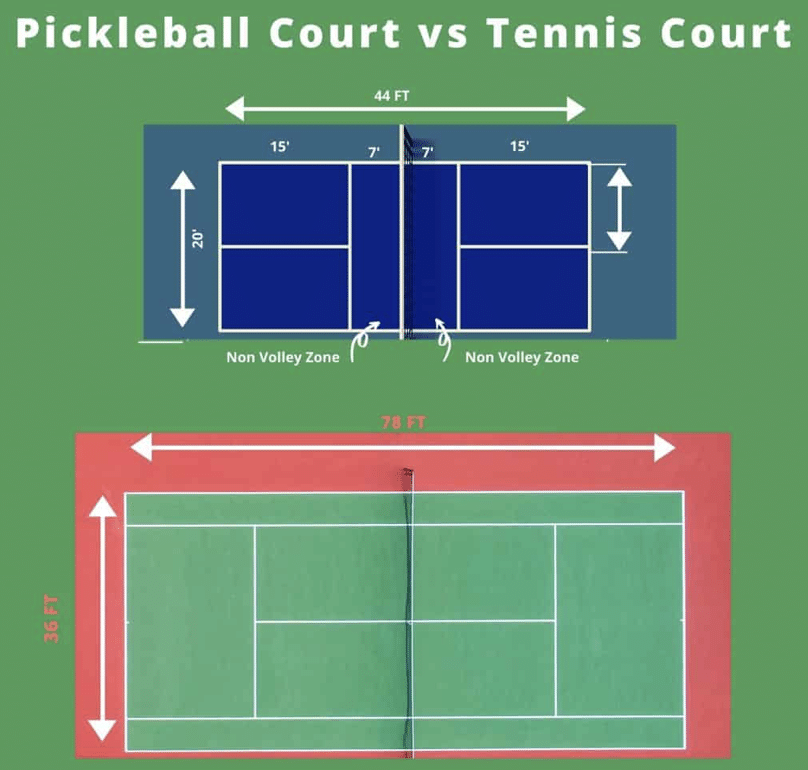
Pickleball courts are much smaller than tennis courts. Here’s a direct comparison:
| Sport | Court Length | Court Width | Net Height (center) | Special Areas |
|---|---|---|---|---|
| Pickleball | 44 ft | 20 ft | 34 in | Non-volley zone (“kitchen”) |
| Tennis (Singles) | 78 ft | 27 ft | 36 in | Service boxes, baseline, sidelines |
| Tennis (Doubles) | 78 ft | 36 ft | 36 in | Service boxes, alleys |
Pickleball courts are about one-fourth the size of a tennis court. The non-volley zone (often called the “kitchen”) is a unique feature in pickleball. It’s a 7-foot area on both sides of the net where players cannot volley (hit the ball in the air).
Tennis courts have more complex markings, with service boxes, baselines, doubles alleys, and specific zones for singles and doubles.
Surface Types
Both sports can be played on different surfaces: hard courts, clay, grass, or artificial turf. However, pickleball is most commonly played on hard courts, often shared with tennis courts using special tape or paint.
Net Differences
- Pickleball nets are slightly lower, especially at the center (34 inches vs. tennis’s 36 inches).
- Tennis nets are wider and taller, covering a larger area.
Equipment: Rackets, Balls, And Gear
The equipment used in pickleball and tennis is also quite different, affecting how the games are played.
Paddle Vs. Racket
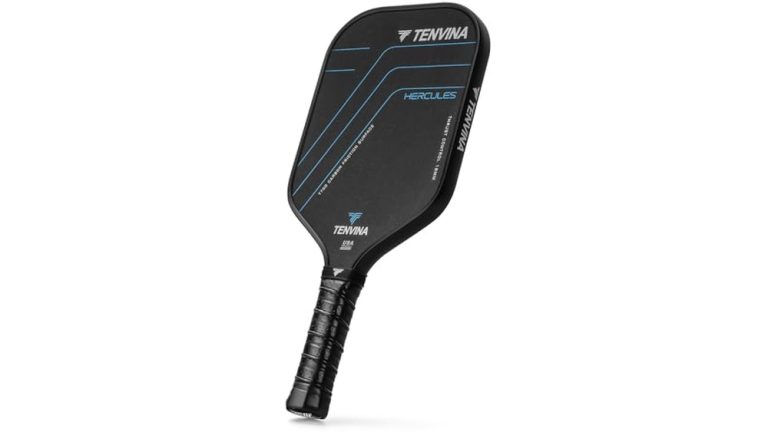
- Pickleball paddles are solid, made of wood or composite materials, about 8 inches wide and 15-16 inches long. They have no strings.
- Tennis rackets are larger, strung with nylon or other materials, typically 27 inches long and much lighter.
Ball Comparison
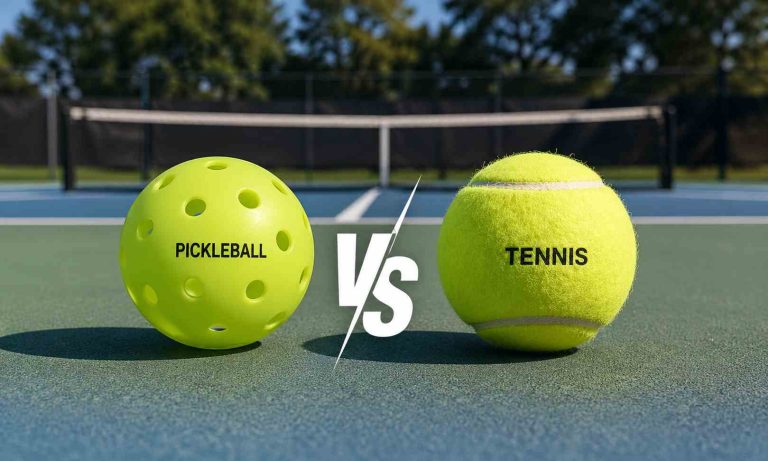
Pickleball uses a plastic ball with holes, similar to a whiffle ball. It’s lighter and moves slower. Tennis uses a pressurized rubber ball covered with felt, which bounces higher and travels faster.
| Sport | Ball Type | Diameter | Weight |
|---|---|---|---|
| Pickleball | Plastic, with holes | 2.87-2.97 in | 0.78-0.935 oz |
| Tennis | Rubber with felt | 2.57-2.70 in | 1.975-2.095 oz |
Shoes And Clothing
Both sports recommend non-marking court shoes for safety and grip. Tennis players often wear more specialized gear for pro matches, while pickleball is more relaxed about attire.
Serving Rules: The Start Of Every Rally
Serving is a crucial part of both games, but the rules for serving are very different.
Pickleball Serving
- The serve must be hit underhand, with the paddle below the waist.
- The ball is served diagonally, landing in the opposite service box.
- The server must stand behind the baseline, between the sideline and the center line.
- Only one serve attempt is allowed (except if the ball touches the net and lands in the right box—a “let”).
- Both feet must stay behind the baseline until contact is made.
- In doubles, each team member serves before the serve passes to the other team (except at the very first serve of the game).
Tennis Serving
- The serve is hit overhand, often with a powerful motion.
- Players serve from behind the baseline, alternating sides with each point.
- The ball must land in the diagonal service box.
- Two serve attempts are allowed per point. If the first serve fails, a second is given.
- If the ball touches the net and lands in the correct box, it’s a “let,” and the serve is replayed.
Unique Pickleball Rule: The Double Bounce
In pickleball, after the serve, the ball must bounce once on each side before players can volley. This is called the double bounce rule. Tennis doesn’t have this rule; players can volley immediately after the return.

Credit: www.rockstaracademy.com
Scoring System: Points, Games, And Sets
How points are counted is one of the biggest differences between pickleball and tennis.
Pickleball Scoring
- Games are played to 11 points, and you must win by 2 points.
- Points can only be scored by the serving team.
- Matches are usually best 2 out of 3 games.
- Scores are announced in the format: Serving team score, receiving team score, server number (in doubles).
For example: “6-4-2” means the serving team has 6, the opponents have 4, and the second server is serving.
Tennis Scoring
- Points progress in this sequence: 0 (love), 15, 30, 40, game.
- If both players reach 40 (called “deuce”), one must win two consecutive points to win the game.
- Games are grouped into sets: The first to win 6 games (by 2) wins a set.
- Matches are usually best of 3 or 5 sets.
- Points can be won by either player/team, regardless of who is serving.
| Feature | Pickleball | Tennis |
|---|---|---|
| Game Length | To 11 (win by 2) | 6 games (win by 2) |
| Match Format | Best 2 of 3 games | Best 3 of 5 sets |
| Who scores? | Only serving team | Either player/team |
Non-obvious Insight: Mental Impact
Pickleball’s “only the server scores” system creates shorter, more intense rallies and changes strategy. In tennis, every rally can win a point, making every shot critical.
Gameplay Rules: Rallies, Volleys, And Court Movement
The way rallies are played and how players move are shaped by specific rules.
Pickleball Gameplay
- Non-volley zone: Players cannot volley the ball within 7 feet of the net (the kitchen). If they step in while volleying, the point is lost.
- Double bounce: After the serve, each side must let the ball bounce once before volleying.
- No overhand shots: All shots must be made below the waist, including the serve.
- Quick exchanges: Because of the smaller court and slower ball, rallies are often fast and close to the net.
Tennis Gameplay
- No non-volley zone: Players can volley anywhere on the court, including right at the net.
- Overhand shots allowed: Players often hit powerful serves and smashes.
- Longer rallies: The court size and ball speed allow for longer rallies and more running.
- Spin and power: Tennis players use topspin, slice, and heavy shots.
Unique Pickleball Strategies
Pickleball rewards quick reflexes and finesse. Dinking (soft shots to the kitchen), quick volleys, and placement are key. Tennis focuses more on speed, power, and endurance.
Doubles And Singles: Team Play Differences
Both sports can be played as singles or doubles, but their doubles rules are not the same.
Pickleball Doubles
- Both players serve before the serve passes to the opponents (after the first serve of the game).
- Players switch sides only after scoring a point.
- The non-volley zone is especially important in doubles, since players often crowd the net.
Tennis Doubles
- One player serves for the entire game, then the serve rotates to the other team.
- Players switch sides after every odd-numbered game.
- The “doubles alley” (extra side area) is used in doubles, making the court wider.
Singles Differences
Pickleball singles is played on the same court, but with different serving rules (serving from the right if the score is even, left if odd). Tennis singles uses a narrower court—no doubles alley.
Faults And Penalties: What Causes A Lost Point?
Understanding faults is important for fair play. Both sports have their own list of mistakes that cause you to lose a point.
Pickleball Faults
- Serving out of bounds or into the wrong box.
- Volleying in the non-volley zone (kitchen).
- Hitting the ball into the net or out of bounds.
- Not letting the ball bounce as required (violating the double bounce rule).
- Touching the net or crossing under it.
- Ball hitting a player or their clothing.
Tennis Faults
- Double fault on serve (missing two attempts).
- Ball hit out of bounds or into the net.
- Player or racket touching the net.
- Ball touching a player before bouncing.
- Stepping over the baseline during a serve (foot fault).
Non-obvious Insight: Fault Frequency
Pickleball’s unique rules (non-volley zone, double bounce) create faults that don’t exist in tennis. Beginners often lose points by accidentally volleying in the kitchen or forgetting the double bounce rule.
Game Pace And Physical Demands
Many people choose pickleball because it’s easier on the body and less demanding than tennis. Let’s compare:
Pickleball
- Shorter court means less running.
- Underhand serve reduces stress on the shoulder.
- Lower impact, often chosen by older adults or those with joint issues.
- Games are quicker (often under 20 minutes).
Tennis
- Larger court requires more running and stamina.
- Overhand serve and powerful shots demand more strength and flexibility.
- Matches can last hours, especially at the professional level.
Data On Physical Impact
A 2021 study found that pickleball players averaged about 2,000 steps per game, while tennis players could reach 6,000-8,000 steps per match. Injury rates are lower in pickleball, but both sports are healthy options for cardiovascular fitness.
Accessibility And Age Groups
Pickleball’s rules make it more accessible for all ages and abilities.
- The smaller court and slower ball make it easier for children and seniors.
- Pickleball is popular in retirement communities, parks, and schools.
- Tennis is more demanding, but offers higher-level competition and athletic training.
Growth Among Seniors
Pickleball has seen a 40% growth among players age 55+, according to the USA Pickleball Association. Tennis remains popular with all ages, especially at youth and professional levels.
Credit: www.youtube.com
Rule Adaptations And Common Misunderstandings
Many beginners mix up the rules between pickleball and tennis. Here are some common mistakes:
- Volleying in the kitchen: In pickleball, this is not allowed. In tennis, players can volley anywhere.
- Serving style: Tennis uses overhand; pickleball uses underhand only.
- Scoring confusion: Pickleball’s serving team-only scoring is often misunderstood by tennis players.
- Double bounce rule: New players often forget to let the ball bounce before volleying in pickleball.
- Court lines: Tennis has more complex lines; pickleball’s are simpler but include the kitchen.
Rule Changes And Updates
Both sports update their rules regularly. For pickleball, the USA Pickleball Association releases a new rulebook each year. Tennis rules are managed by the International Tennis Federation (ITF).
Recent changes in pickleball include:
- Allowing drop serves (ball can be dropped, not thrown).
- Clarifying foot faults and kitchen violations.
- Updating scoring methods for tournaments.
Tennis rules rarely change, but recent updates include coaching rules and technology use in pro matches.
Why Players Switch Between Pickleball And Tennis
Many tennis players are trying pickleball for fun or due to injury. Pickleball offers:
- Less physical strain
- Quicker games
- Social, friendly atmosphere
Tennis players bring skills like volleying and court movement, but must adjust to pickleball’s unique rules.
Summary Table: Key Pickleball Vs Tennis Rules
| Aspect | Pickleball | Tennis |
|---|---|---|
| Serve style | Underhand only | Overhand allowed |
| Who scores? | Only serving team | Either player/team |
| Non-volley zone | Yes (“kitchen”) | No |
| Double bounce rule | Yes | No |
| Court size | 44×20 ft | 78×27/36 ft |
| Ball type | Plastic, holes | Rubber, felt |
| Game length | To 11 | To 6 (set) |
| Match format | Best 2 of 3 games | Best 3 of 5 sets |
| Physical demand | Lower | Higher |
Practical Tips For Switching Between Pickleball And Tennis
If you’re moving from tennis to pickleball (or vice versa), keep these tips in mind:
- Adjust your serve: Practice the underhand motion for pickleball and the overhand for tennis.
- Watch your footwork: The smaller court in pickleball needs quick, short steps. Tennis requires longer runs.
- Learn the kitchen rules: In pickleball, avoid volleying in the non-volley zone.
- Change your grip: Pickleball paddles feel different from tennis rackets; find a comfortable grip.
- Understand scoring: Don’t assume tennis scoring works for pickleball—study the serving team-only point system.
- Master the double bounce: Always let the ball bounce once on each side after the serve in pickleball.
- Play with others: Pickleball is social and often played in groups; try doubles for fun.
- Don’t over-swing: The lighter pickleball paddle and ball mean less power is needed.
Which Sport Is Right For You?
Your choice depends on your goals, fitness, and interests.
- Pickleball is easy to learn, social, and less physically demanding.
- Tennis offers higher competition, longer rallies, and more intense workouts.
- If you enjoy quick games with friends, pickleball is ideal.
- If you prefer solo play, power, and competition, tennis might suit you better.
Many clubs now offer both sports, so you can try each and see which fits your style.
Real-world Example: Community Impact
Cities across the US are converting old tennis courts into pickleball courts. In 2023, Seattle built over 30 new pickleball courts, boosting local recreation. Some parks offer “dual-use” courts with painted lines for both sports. This trend shows how pickleball’s simpler rules and accessibility are changing communities.
Non-obvious Insight: Why Rules Matter For Beginners
Many beginners ignore the “kitchen” and “double bounce” rules in pickleball, leading to confusion and lost points. Understanding these unique rules makes the game more fun and prevents frustration. Tennis players must remember that every rally can score a point, so focus is critical at all times.
Where To Learn More
For official rules and updates, visit the USA Pickleball Association. They offer detailed guides, videos, and community resources.
FAQs (Are Pickleball Rules the Same As Tennis)
Is Pickleball Easier Than Tennis For Beginners?
Yes, pickleball is usually easier for beginners. The smaller court, lighter ball, and simple rules make it less physically demanding and faster to learn. Many seniors and children start with pickleball because it’s gentle on the body and easy to play.
Can Tennis Players Play Pickleball Without Learning New Rules?
Not exactly. While tennis players have good racket skills, they must learn pickleball’s unique rules like the non-volley zone, underhand serve, and double bounce rule. Switching sports is fun, but some practice is needed to avoid common mistakes.
Why Does Pickleball Only Allow Points On The Serve?
This rule keeps games short and intense. Only the serving team can score, which changes strategy and makes each serve important. It also gives the receiving team a chance to take control. This is different from tennis, where any rally can win a point.
What Is The “kitchen” In Pickleball?
The kitchen is the non-volley zone, a 7-foot area on both sides of the net. Players cannot volley the ball (hit it in the air) while standing in the kitchen. This rule makes rallies safer and more strategic, stopping players from dominating at the net.
Are Pickleball And Tennis Balls The Same?
No. Pickleball uses a light, plastic ball with holes (like a whiffle ball), while tennis uses a pressurized rubber ball covered in felt. The balls bounce and move differently, so each sport requires its own ball.
Both pickleball and tennis offer exciting ways to stay active and social. Their rules shape how the games are played, who enjoys them, and what skills are needed. If you understand the differences, you’ll have more fun and improve faster, whether you’re new or experienced.
Try both sports, respect their unique rules, and see which one fits your style.
Credit: topspinpro.com