Pickleball Vs Tennis Rules: Key Differences Every Player Should Know

Pickleball Vs Tennis Rules: A Detailed Comparison
Pickleball and tennis are two of the most popular racquet sports played worldwide. While they share some similarities, their rules, gameplay, and strategies are quite different. Understanding these differences is essential, especially for beginners or those switching between sports. This guide will help you discover how pickleball and tennis rules compare, so you can play confidently, avoid common mistakes, and enjoy each sport fully.
Pickleball’s rise in popularity has surprised many tennis players. In the US alone, over 4. 8 million people now play pickleball, according to the Sports & Fitness Industry Association. Tennis, meanwhile, has a long history and remains a favorite, with nearly 23.
6 million players in the US. Both games have their own unique culture and rulebook. Let’s dive into the main differences and similarities, focusing on practical insights that matter for real play.
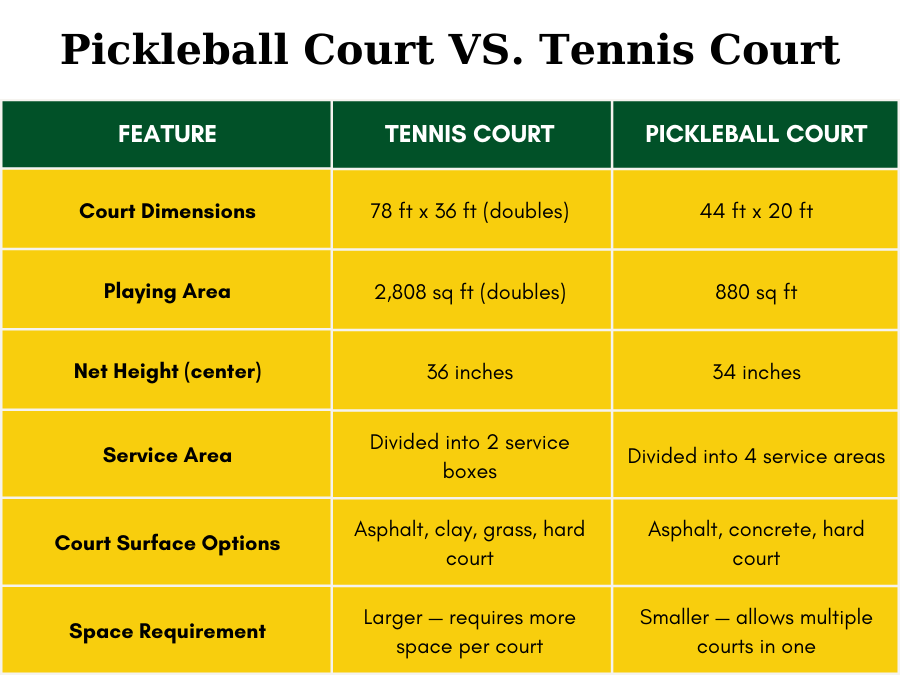
Court Size And Layout
One of the first things you’ll notice is the court size. This affects movement, strategy, and scoring.
| Feature | Pickleball | Tennis |
|---|---|---|
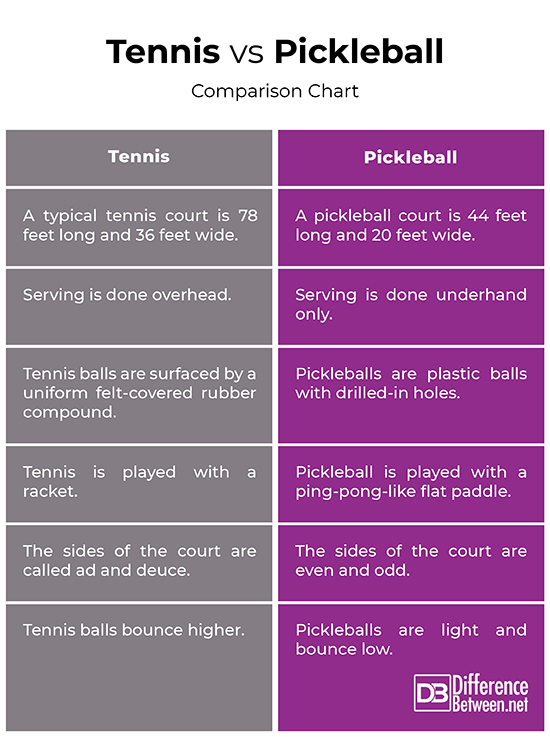
| Court Dimensions | 20 x 44 feet | Singles: 27 x 78 feet Doubles: 36 x 78 feet |
| Net Height (center) | 34 inches | 36 inches |
| Service Area | Divided into left and right “service courts” | Divided into deuce and ad courts |
| No-Volley Zone | 7-foot “kitchen” from net | No “kitchen”; volleys allowed anywhere |
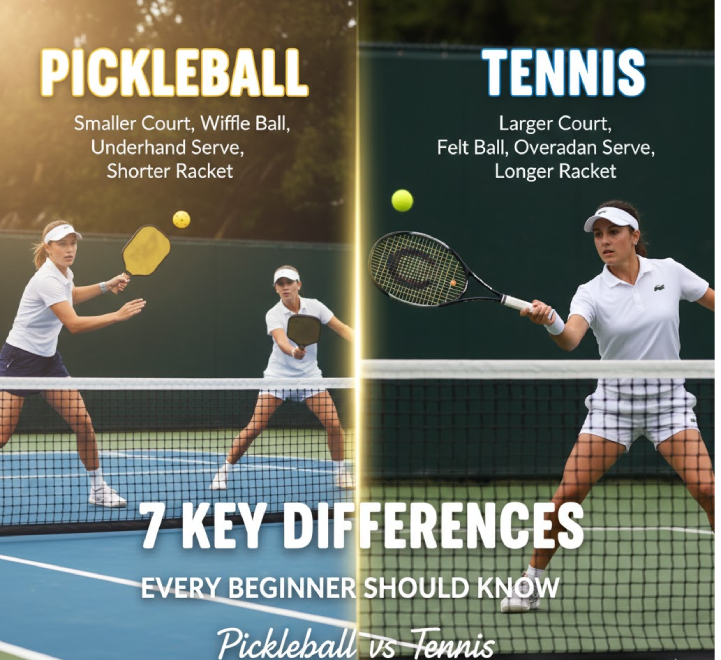
The pickleball court is much smaller than a tennis court. This makes pickleball less physically demanding in terms of running, but more focused on quick reactions. The net height in pickleball is slightly lower, which changes how balls are played at the net.
A unique feature in pickleball is the no-volley zone, called the “kitchen.” Players cannot volley (hit the ball in the air) while standing in this area. Tennis has no such restriction; volleys are allowed anywhere on the court.
Equipment Differences
The rules for equipment also differ sharply between the two sports. Understanding these details will help you avoid common mistakes.
Paddles And Racquets
- Pickleball: Players use solid paddles, usually made from wood, composite, or graphite. The paddle is smaller and lighter than a tennis racquet.
- Tennis: Players use strung racquets, typically made from graphite or composite materials, with a larger head and longer handle.
Balls
- Pickleball balls are plastic with holes (similar to a wiffle ball). Outdoor balls are heavier and have smaller holes compared to indoor balls.
- Tennis balls are rubber, covered with felt, and are pressurized for bounce.
Shoes
Both sports require specific shoes. Tennis shoes are designed for lateral movement and durability on hard courts. Pickleball shoes are similar but focus on grip and quick stops, especially on indoor surfaces.
Net And Posts
Tennis nets are longer and slightly higher at the posts than at the center. Pickleball nets are shorter, with a consistent height.
Credit: nerulgymkhana.com
Serving Rules
Serving is a major area where rules differ. Many beginners make mistakes here, especially when switching between sports.
| Aspect | Pickleball | Tennis |
|---|---|---|
| Serve Method | Underhand only | Overhand or underhand |
| Serve Direction | Diagonal to opposite service court | Diagonal to opposite service box |
| Serve Bounce | Ball must bounce once before return | Ball can be returned in air or after bounce |
| Faults Allowed | No second serve | One fault allowed; second serve given |
In pickleball, serves must be made underhand, with the paddle below the waist. The ball must be hit diagonally and land in the opposite service court. After serving, the ball must bounce once on each side before volleys are allowed. This is called the double bounce rule.
Tennis allows overhand and underhand serves. Players serve diagonally into the opponent’s service box. If the first serve is a fault, players get a second serve. There is no double bounce rule; returns can be made on the volley.
Common Beginner Mistakes
- In pickleball, many new players forget the double bounce rule and volley too soon.
- In tennis, beginners often serve from the wrong side or forget to switch sides after each point.
Scoring Systems
Scoring in pickleball and tennis can be confusing for new players. Here’s how each system works.
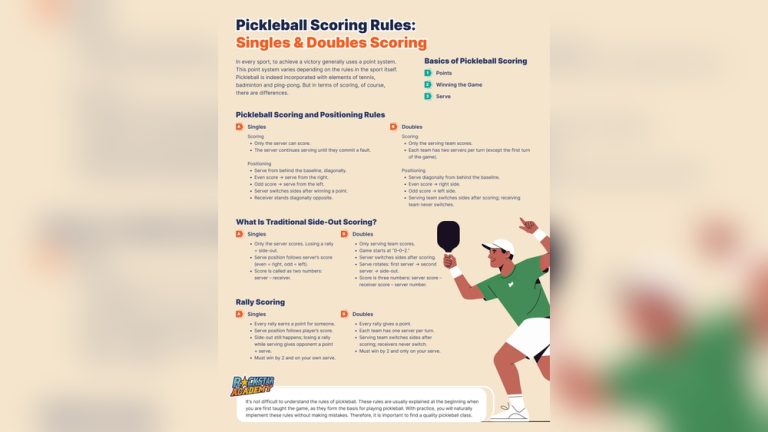
Pickleball Scoring
- Games are usually played to 11 points (sometimes 15 or 21).
- Points can only be scored by the serving team.
- Players must win by two points.
- Doubles scoring: The server’s number (1 or 2) and the team’s score are announced before each serve.
Tennis Scoring
- Points are counted as 15, 30, 40, game.
- Games are grouped into sets. A set is won by taking at least 6 games, with a 2-game lead.
- Matches are best of 3 or 5 sets.
- Points can be scored by either player/team, regardless of who served.
Example Scoring Sequences
- Pickleball: “8-6-2” means serving team has 8 points, receiver has 6, and the server is the second player.
- Tennis: “30-15” means server has 30, receiver has 15.
Key Differences
The win-by-two rule is strict in pickleball. Tennis sometimes uses tie-breaks if sets are tied. In pickleball, scoring only on your serve means rallies are often longer.
Faults And Penalties
Both sports penalize mistakes, but the details differ.
Pickleball Faults
- Serving into the net or out of bounds.
- Volleying in the kitchen.
- Failing to follow the double bounce rule.
- Ball landing outside the court.
- Ball touching any part of the player’s body except the hand holding the paddle.
Tennis Faults
- Double fault on serve (loses point).
- Ball landing outside the lines.
- Net violations (touching net with body or racquet).
- Foot faults (stepping over baseline during serve).
Notable Differences
Pickleball faults often relate to the no-volley zone and serve rules. Tennis faults are mostly about serve and court boundaries.
Doubles Vs Singles Rules
Both sports can be played in singles or doubles formats, but the rules vary.
Pickleball Doubles
- Teams of two.
- Both players serve before the other team gets the serve.
- The court is the same size as singles.
- Rotation: After winning a point, the server switches sides with their partner.
Tennis Doubles
- Teams of two.
- Only one player serves per game; partners switch serving each game.
- The court is wider (doubles alleys are in play).
- Partners can move freely but usually cover specific areas.
Movement And Positioning
Pickleball doubles requires careful coordination to avoid stepping in the kitchen. Tennis doubles often involves one player at the net and one at the baseline.
In-play Rules And Ball Handling
How the ball is played during rallies is another key difference.
Pickleball
- Ball must bounce once on each side after the serve before volleys are allowed.
- Volleys cannot be played in the kitchen.
- “Let” serves (ball hits net and lands in service area) are replayed.
Tennis
- Ball can be played as a volley anytime, except on the serve.
- No restriction on where volleys can be played.
- “Let” serves (ball hits net and lands in service box) are replayed.
Unique Features And Rule Variations
Some rules are unique to each sport. These can affect strategy and gameplay.
Pickleball
- No-volley zone (kitchen): Adds tactical depth, prevents powerful smashes at the net.
- Paddle grip: No rule about grip style, but most players use continental grip.
- Court surface: Pickleball is played on hard, gym, or outdoor surfaces.
Tennis
- Spin and serve variety: Tennis allows more serve types, including topspin, slice, and flat.
- Court surface: Tennis is played on clay, grass, or hard courts; surface affects ball speed and bounce.
- Tie-breaks: Used to decide sets at 6-6.
Skill And Strategy Differences
The rules impact how each sport is played. Many players find pickleball easier to start, but both sports demand skill.
Pickleball
- Quick reflexes are crucial due to the small court.
- Shots are often soft dinks or rapid volleys.
- Placement is more important than power.
Tennis
- Power and endurance play a bigger role.
- Topspin and slice shots are common.
- Long rallies test stamina.
Transitioning Between Sports
Players switching from tennis to pickleball often struggle with the underhand serve and kitchen rules. Pickleball players moving to tennis must learn to use power and manage larger court movement.
Rule Changes And Evolution
Both sports have adjusted rules over time, often to make play faster or more accessible.
Pickleball
- The “let serve” rule was removed in official tournaments—now, if the ball hits the net and lands in the service box, play continues.
- The scoring system has seen minor adjustments for tournament play.
Tennis
- Tie-breaks were added to speed up matches.
- Technology, such as Hawk-Eye, is used to review line calls in major tournaments.
Common Questions And Misconceptions
Many new players are confused by similar terms and rules. Here are some of the most misunderstood points:
- “Kitchen” confusion: Many think you can step into the kitchen after the ball bounces. In fact, you can—but you must not volley there.
- Scoring in doubles: Beginners often forget to announce the server number in pickleball doubles.
- Serve styles: Some think tennis requires overhand serves only. Underhand is allowed, though rare.
- Court lines: In pickleball, the lines are part of the court. In tennis, lines are also “in,” but the side alleys are only used in doubles.
Real-world Examples
Let’s look at how these rules affect play in practice.
- In pickleball, a rally often starts slow, with both teams dinking at the net. The kitchen rule forces players to be careful with volleys. The game speeds up as players try to push opponents out of position.
- In tennis, rallies can be powerful from the start. Players use serves to gain advantage, aiming for aces or forcing weak returns. The larger court means more running and longer points.
Comparison Table: Pickleball Vs Tennis Rules
Here’s a summary of the main differences:
| Rule Aspect | Pickleball | Tennis |
|---|---|---|
| Serve | Underhand, cross-court, double bounce rule | Overhand or underhand, cross-court, no double bounce |
| Scoring | Only serve team scores, games to 11/15/21, win by 2 | Both players score, games to 6/set, best of 3/5 sets |
| No-volley zone | Yes (kitchen, 7 feet from net) | No |
| Doubles | Same court size, rotation after point | Wider court, rotation after game |
| Ball type | Plastic with holes (wiffle ball) | Pressurized felt ball |
| Faults | No second serve, kitchen violations | Double faults allowed, net/foot faults |
Key Insights Beginners Often Miss
- The double bounce rule in pickleball changes the flow of early rallies and prevents quick net play.
- In tennis, tie-breaks are used only in certain sets, and the scoring system can confuse new players. Learning the sequence (15-30-40-game) is essential.
- In pickleball doubles, the server number (1 or 2) must be announced, which affects rotation and scoring.
- Pickleball’s no-volley zone forces players to use soft shots near the net, adding a layer of tactical skill not found in tennis.
Rule Enforcement And Refereeing
Tournaments in both sports use referees, but the approach is different.
Pickleball
- Referees check for kitchen violations and correct serving order.
- Most recreational games are self-officiated.
Tennis
- Referees and line judges are common in professional play.
- Technology assists with line calls in major events.
Adaptations For Beginners And Youth
Both sports adapt rules to help new players learn.
Pickleball
- Lower net height for children.
- Modified scoring (games to 7).
- Use of lighter paddles and slower balls.
Tennis
- Smaller courts for youth.
- “Red, orange, green” balls for different ages and skill levels.
- Shorter sets for beginners.
Credit: www.differencebetween.net
Health And Safety Considerations
The rules affect the physical demands of each sport.
- Pickleball: Less running, lower risk of overuse injuries, but quick changes of direction can strain knees.
- Tennis: More running, higher risk of muscle strains, especially in long matches.
Both sports recommend proper warm-up, hydration, and use of protective gear.
Cultural And Social Impact
Pickleball is often praised for its social nature—games are quick, and players rotate frequently. Tennis has a more formal tradition, but both sports encourage community and teamwork.
According to the USA Pickleball Association, pickleball has grown fastest among players aged 55+, thanks to its accessibility. Tennis remains popular with all age groups, especially in schools and clubs.
Where To Learn More
For official rules and updates, visit the USA Pickleball Association and the United States Tennis Association websites.
Frequently Asked Questions
What Is The Double Bounce Rule In Pickleball?
The double bounce rule means the ball must bounce once on each side after the serve before players can volley. This prevents quick net attacks right after the serve and encourages longer rallies.
Can You Volley In The Kitchen In Pickleball?
No, you cannot volley while standing in the kitchen (no-volley zone). If you step into the kitchen and hit the ball before it bounces, it’s a fault. However, you may enter the kitchen to play a ball that has bounced.
How Is Scoring Different In Pickleball Vs Tennis?
In pickleball, only the serving team can score points, and games are usually played to 11, 15, or 21 points, with a win-by-two rule. In tennis, both players or teams can score, using a sequence of 15, 30, 40, and game, with sets and matches.
Are There Second Serves In Pickleball?
No, pickleball does not allow a second serve. If the serve is a fault (out or into the net), the next server or team takes over. Tennis allows a second serve after the first fault.
What Happens If The Ball Lands On The Line?
In both sports, balls landing on the line are considered in. In tennis, this applies to all lines except the doubles alleys in singles play. In pickleball, the line is always part of the court.
Pickleball and tennis each offer a unique experience. Understanding their rules not only helps you play better but also lets you appreciate the strategy and skill behind each game. Whether you enjoy the rapid exchanges of pickleball or the powerful rallies of tennis, knowing the rules is the first step to mastering the sport.
Credit: superiorplay.com